Newport Beach vehicle noise tickets: they are invalid, and here is how to fight one
California already regulates loud vehicles, with an objective decibel standard, a state test, and a court. Since 2025 Newport Beach has been writing its own citations under NBMC 10.28.007 instead, with no standard, no test, and the fine paid to the city. State law does not permit this.
The argument that these citations are preempted "may be true," and a correct ruling "would invalidate the entirety of the City's regulation as to noise emanating from vehicles."
If you were cited under 10.28.007 for engine or exhaust noise, you have 21 days from service and nothing to lose by contesting but time. Losing costs exactly what paying costs, winning refunds every dollar, and this site carries the load: the steps, the argument, and your documents generated in minutes.
This site has one goal. Every one of these citations thrown out, and the program with them. The legality question is before Superior Court in my case. What makes it work is volume, because every contest adds one more case to the record a court will read.
The overwhelming majority of citations show no documented hearing outcome in the city's own records. The program survives because paying is easier than fighting. Do not make it easy. One correct ruling ends the whole thing, and the city's own hearing officer said so in writing. Nothing on this page is legal advice. It covers municipal citations for motor vehicle noise only.
762citations under section 10.28.007 in the city's ledger, 2021 through July 10, 2026
0hearing decisions rejecting the preemption argument
$129,719129,719 dollarscollected on section 10.28.007 citations per the city's ledger
0fields in the ledger recording a hearing outcome, refund, or reversal
If you have a citation, start here
You have 21 days from service to request a hearing. A hardship waiver has a 15-day deadline. The clock is already running.
The fastest path is the document generator. It fills in all three contest documents from your details and computes conservative deadline dates from the issue date on your citation. Nothing you type leaves your browser. If you would rather talk it through first, the buttons below open a conversation with the legal framework, the statute numbers, and the deadlines already loaded. The contest documented on this page began as a five-minute conversation with an AI assistant.
The prompt sent to the assistant contains only the public information on this page, none of your details. Either way, read the steps before you file anything.
And if you want a person, describe your situation through the contact form and I will look at it and share guidance from my own contest, the public records, and the documents on this site. I am not a lawyer, nothing I send is legal advice, and I cannot represent you or decide your arguments for you. Every filing and deadline stays yours, and the 21-day clock runs whether or not you hear back from me first. But you will not be starting alone.
Two systems exist for loud vehicles. California's has a 95 dBA standard and a state referee test. Newport Beach's municipal citation has an officer's opinion and a fine paid to the city. The data.
State law bars the second system. Vehicle Code section 21 prohibits local ordinances on matters the code covers unless the code itself expressly authorizes them. The burden of naming that authorization falls on the city, and in this record it never has. Even Newport Beach's own noise code notes that vehicle noise regulation may be state-preempted. The law.
Not about my car. About the city's own document. The citation's written description includes "mod. exhaust / revving veh." Exhaust modification is governed by Vehicle Code section 27151. Either the city enforced a state matter on the citation's face, or it wrote down an equipment allegation no one inspected, which the officer said on camera he was not citing. What happened.
The city's own hearing officer has now said it. The preemption argument "may be true," and a correct ruling "would invalidate the entirety" of the program. He declined to rule on it and pointed to a court. The decision itself.
The ordinance did not change. Enforcement did. 6 citations in 2024, then 221 in 2025 and 525 by July 10, 2026. What changed.
Do not argue about your exhaust. California sets vehicle noise rules, not cities, and the argument does not depend on what your car is. Fact arguments lost almost every hearing. The preemption argument has never been rejected. The hearings.
Contest yours. Losing costs exactly what paying costs, winning refunds the deposit, and there are no points and no insurance impact either way. You have 21 days. The steps, the templates.
This is a funded, ongoing campaign. It is staffed, and the reports and filings are already in motion. What it is doing.
A note for California attorneys. When Royal Oak, Michigan ran this same program in 2017, a single letter from a local lawyer ended it and 130+ tickets were dismissed. The case file on this page is ready for the same use. The contact form has a lane for you.
Everything from here down is the full record. You do not need it to fight your ticket. It is here so every claim above can be checked against its source.
What happened
In spring 2026, I was pulled over on a public street in Newport Beach. I had revved the engine of my car twice while stopped. The sound lasted a few seconds in total. What the car was does not matter to the legal argument on this page, and that is the point. The argument does not depend on the vehicle.
The officer issued a $200 administrative citation under Newport Beach Municipal Code section 10.28.007, "Loud and Unreasonable Noise," the city's general nuisance noise ordinance. The description written on the citation reads "loud and unreasonable noise (mod. exhaust / revving veh.)". Note what the officer wrote. Modified exhaust is a vehicle equipment allegation, and vehicle exhaust modification is governed by Vehicle Code section 27151, with the state's inspection and testing process attached. No decibel meter was used, no measurement was taken, and no one ever inspected the exhaust the citation described as modified.
That description leaves the city two readings, and both are bad. If the alleged modification was part of the basis for the citation, the city was enforcing a matter the Vehicle Code governs, on the face of its own document. If it was not part of the basis, the citation carries an unverified vehicle equipment allegation written into the field that states the basis for the fine. Either way, the citation's own words undercut the claim that this was generic nuisance conduct that only incidentally involved a car.
I contested it. I requested a hearing with the required $200 deposit, pulled the body-worn camera recording through a records request, and filed written evidence arguing the citation is invalid under state law.
The recording shows the officers discussing the administrative citation before making contact with me. It also records the citing officer walking through the choice out loud. He named the alternative, a state Vehicle Code ticket over the exhaust with the referee inspection attached, and said he had no need to go that route. When I disputed the modified-exhaust description, he answered that the modification question made no difference to the citation he was writing, and characterized the administrative citation as a civil matter handled through the city rather than a court. He added that the department focuses on this enforcement because of resident complaints about engine revving. So the recording preserves the sequence in the officer's own account. The state process for the vehicle side of the episode, recognized and set aside, and a municipal fine issued in its place, for conduct the department says it makes a point of enforcing. The state route he named is the one with the objective testing process, described below.
At the hearing I contested none of the facts. The entire defense was that the city had no legal authority to issue the citation. The hearing officer's written decision upheld the citation. The full decision is here, redacted only for personal information, so no one has to take this page's word for what it says. What it says deserves to be read slowly:
This may be true but such an inquiry is outside the scope of this hearing officer's purview. If correct, such a determination would invalidate the entirety of the City's regulation as to noise emanating from vehicles. Such a determination should be made by a court with the law fully briefed by all parties. This hearing Officer will not invalidate a legislative act in its entirety based on an argument in an administrative hearing.
Read it again. A lawyer under contract with the city, ruling on the city's citation, wrote that the argument against the entire program "may be true," and that he would not consider it, for the stated reason that considering it could invalidate everything the city is doing. The decision does not say the argument failed. It says the argument was not reached, and gives the breadth of the consequence, invalidating the entire program, as the reason it must go to a court.
Weigh the word "may." A decision with an answer to the argument would give the answer, and this one gives none. The passage names no case, no statute, and no reason the argument fails. "May be true" is what is left when a decision neither rejects an argument nor adopts it. The word keeps the question open, and an open question is the one thing that lets the program continue.
Notice who wrote that. An adjudicator whose firm is under contract with the city, ruling on the city's own citation, went as far as writing that the argument against his client's entire program may be correct and that a court should decide it. From that seat, that is the strongest concession the process can produce, and the California Supreme Court has condemned the risk built into that seat.
What the California Supreme Court says about city-paid hearing officers
The decision itself recites that the hearing officer "serves as Hearing Officer under contract with the City." In Haas v. County of San Bernardino (2002) 27 Cal.4th 1017, the California Supreme Court held that due process condemns "the risk of bias that arises when an adjudicator's future income from judging depends on the good will of frequent litigants who pay the adjudicator's fee." The city is the frequent litigant here. It pays the fee, and it selects the firm. Read the decision's language with that structure in mind. An adjudicator in that position wrote that the argument against his client's program may be correct, and sent it to a court that does not depend on the city for anything.
So the validity question goes to the court he pointed to. The appeal is filed in Orange County Superior Court under Government Code section 53069.4. Review is de novo, meaning the preemption question is briefed to a judge for the first time, with no deference to the hearing below. The hearing officer wrote it himself: "An appeal of this decision to a higher court may provide such relief." This page will be updated as that proceeds.
One more thing about that decision. The hearing officer signed it four days after the hearing. Among the produced decisions that record both dates, hearing to signed decision averages seven days and never exceeds fourteen, so mine was on the fast end of the record. The city confirmed in writing that it had the results in its administrative process, then let more than two weeks pass before dating the service letter, and its written position is that no deadline governed any of that. From hearing to service, the decision quoted above took a month. The signing was not the slow part.
Four days to sign, twenty-five days to serve
A recipient who misses the 21-day contest window forfeits. The city's side has a deadline too, at least on paper. The code requires the hearing officer to issue a written decision within ten days of the hearing (NBMC 1.05.090(A)). Across the produced hearing decisions that record both dates, the average gap from hearing to signed decision is seven days, and the longest is fourteen. Mine was signed four days after the hearing, well inside that deadline. The city then took twenty-five more days to serve it. Asked about the ten-day provision while I waited, the city's staff responded in writing (the correspondence is in my case file) that it binds only the hearing officer's delivery to the city, that no deadline governs notifying the appellant, and that none exists for the city's administrative processing. The appeal deadline, by contrast, runs against the recipient from service, and it is twenty days.
Alongside the contest, I filed a public records request under the California Public Records Act for the city's citation data. Those numbers are below, followed by the legal argument, the economics of contesting, and templates for anyone who receives one of these citations.
What changed
Not the law. The published history line for section 10.28.007 shows no amendment since 2001, and none of the Vehicle Code sections cited on this page changed in 2025. What changed is what the city did with the section. Citations under it, per the city's own ledger: 1 in 2021, 4 in 2022, 5 in 2023, 6 in 2024. Then 221 in 2025, and 525 in 2026 by July 10.
The city knows the lawful route, because it used to run it. In its own 2021 press release, the police department describes four joint operations with the DMV and the state Bureau of Automotive Repair: 649 vehicles stopped, 500 cited for Vehicle Code violations including loud and modified exhaust, and 72 vehicles inspected on-site by a BAR Referee. That is the state process working exactly as designed. The city's ledger shows one municipal noise citation that year.
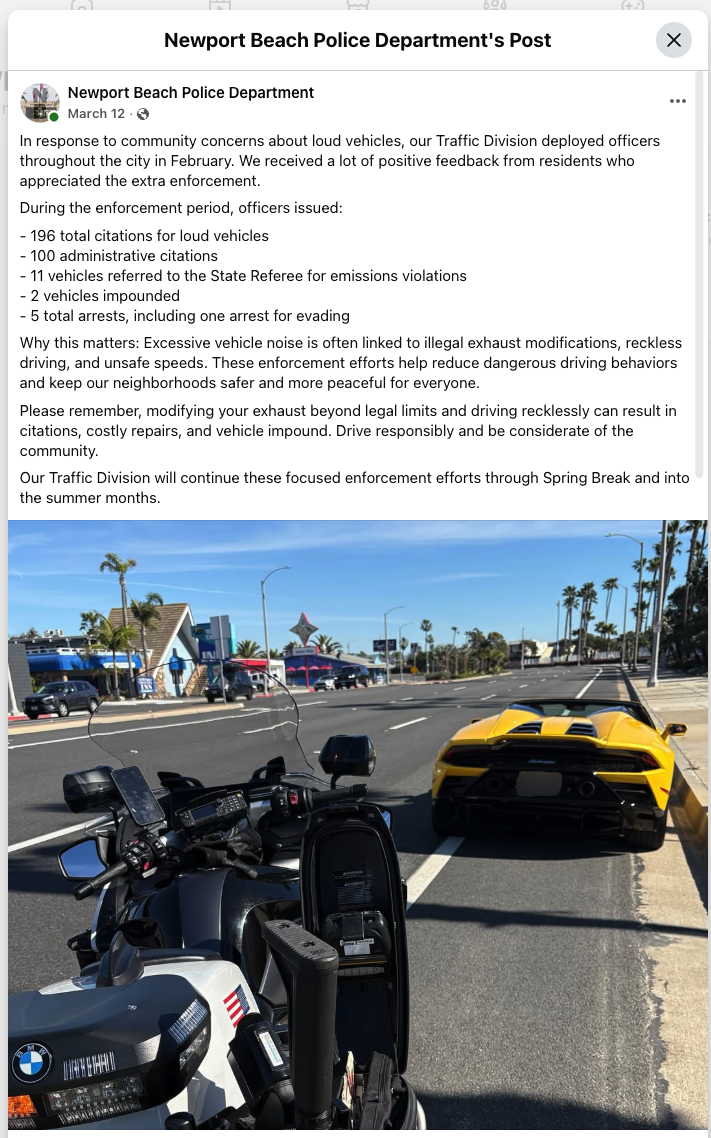
By 2026 the proportions had inverted. In a March 2026 post, the department describes a February deployment that issued 196 citations for loud vehicles, 100 of them administrative citations under the municipal route, with 11 vehicles referred to the State Referee. The same department that ran 72 referee inspections in 2021 ran 11 referrals in 2026 while writing a hundred municipal fines. The sections below document the two routes, the law that governs them, and how the municipal one is decided.
The same department, five years apart
2021: State Referee inspections (city press release, four operations)
72
2021: municipal noise citations (city ledger, full year)
1
Feb 2026: State Referee referrals (department post, one deployment)
11
Feb 2026: municipal administrative citations (same deployment)
100
Sources: City of Newport Beach 2021 press release, NBPD March 12, 2026 post, and the city citation ledger.
In 2021 the city ran the state process at scale and wrote one municipal citation. By 2026 the proportions had inverted.
Why these citations are invalid
The argument on this page applies to municipal citations for motor vehicle noise: engine revving, exhaust sound, and similar. It does not apply to citations for parties, amplified music, construction, or other noise, which state law leaves to cities.
California law does not leave vehicle noise regulation to cities. Each point below is publicly verifiable from the statute, the city's own code, the case law, and the state's own guidance.
Two routes for the same conduct
The state route (the lawful one)
A Vehicle Code ticket leads to an objective referee test against the 95 dBA standard, and a certificate of compliance is grounds for dismissal under CVC 27150.2 and 27150.7.
Vehicle Code ticket
Objective referee test95 dBA standard
Certificate of compliancegrounds to dismiss, CVC 27150.2, 27150.7
The municipal route (the one the city uses)
A 10.28.007 citation, with no standard and no test, requires depositing the full fine before any hearing is held, the hearing cannot rule on the ordinance's validity, and the fine stays with the city.
10.28.007 citationno standard, no test
Deposit the full finebefore any hearing is held
No ruling on validitythe fine stays with the city
Vehicle Code section 21 permits only the first route. The second exists in place of it.
Except as otherwise expressly provided, the provisions of this code are applicable and uniform throughout the state and in all counties and municipalities therein, and a local authority shall not enact or enforce any ordinance or resolution on the matters covered by this code, including ordinances or resolutions that establish regulations or procedures for, or assess a fine, penalty, assessment, or fee for a violation of, matters covered by this code, unless expressly authorized by this code.
Unless the Vehicle Code expressly authorizes it, a city cannot enforce its own ordinance, or collect its own fines, on anything the Vehicle Code covers. Nothing in the Vehicle Code authorizes Newport Beach's vehicle noise citations. The next point shows that vehicle noise is something the code covers, and together those two facts decide every one of these citations.
Notice how the section is built. The bar is universal, and the only exit is the closing clause, "unless expressly authorized by this code," meaning a citable Vehicle Code section. The Legislature writes those grants explicitly. Section 21100, for example, lists matters local authorities may regulate, one by one, from processions to pedicabs, and its subdivision (n)(1) adds that even that list does not authorize a local ordinance that establishes a violation, or assesses a fine, for the same or similar conduct the code already provides for. For vehicle noise there is no grant anywhere in the code. So the burden of naming one falls on the city, and across a contested hearing, a written decision, and the entire record on this page, it never has. That is the state of the law as written. What is missing is a ruling on this ordinance, which no court has yet given, and that is exactly what the appeal now before Superior Court is for.
Why the state wrote the rule this way
The reason for the rule is in its first clause: "applicable and uniform throughout the state." A vehicle is built once and drives everywhere. If each of California's 480-plus cities could set its own vehicle rules, a car that is legal at the factory, legal at the DMV, and legal on the freeway could become a violation by crossing a city line, with no way for the driver to know and no way to comply with every version at once. So the Legislature set vehicle standards once, statewide. The courts describe section 21 as occupying the entire field. A driver who passes the state's exhaust test is compliant in every city in California. Newport Beach's citation program works only if that is false, if compliance with state law in Newport Beach is decided not by the state's standard but by a city officer's ear.
2. Vehicle exhaust noise is a matter covered by the Vehicle Code
The Vehicle Code's muffler and exhaust sections (27150, 27151, and their testing provisions) already govern what counts as too loud, how it is measured, and how a cited driver gets cleared. That is what "covered by this code" means, so section 21 bars the city from regulating it too.
Note what triggers this defense. It is the subject of the citation, not the state of the vehicle. The moment a city writes a citation for vehicle noise, it is regulating a matter the Vehicle Code covers, and section 21 bars it from doing so. Whether the exhaust is stock, modified, or absent never enters the analysis. There is no version of the vehicle that makes a municipal vehicle noise citation valid.
The full state scheme, from standard to dismissal
Vehicle Code section 27150 requires an adequate muffler to prevent "any excessive or unusual noise," and section 27151 prohibits modifications that amplify it. Section 27151(b) then supplies the compliance standard. For vehicles under 6,000 pounds other than motorcycles, a sound level of 95 dBA or less, tested under the current SAE International standard, complies. Section 27150.2 gives a cited driver the right to an objective sound test at a state referee station, and section 27150.7 authorizes the court to dismiss on a certificate of compliance, or where the driver had reasonable grounds to believe the exhaust was in good working order and the vehicle was not being operated in violation. The field is occupied.
3. The city's own code recognizes motor vehicle noise as a category state law may preempt
Newport Beach's Community Noise Control chapter, NBMC Chapter 10.26, assigns every noise subject a destination. Construction, property maintenance, parties, animals, and amplified equipment each get routed to a named city chapter. Motor vehicle noise is handled differently. Section 10.26.035(H) is the only exemption that points outside the municipal code entirely, and its note names motor vehicle noise:
Any activity to the extent regulation thereof has been preempted by state or federal law. NOTE: Preemption may include motor vehicle, aircraft in flight, and railroad noise regulations.
The city's drafters gave every noise subject a destination chapter. Motor vehicle noise alone is named in the note to the preemption exemption, the one provision pointing outside the municipal code. The citations run past a warning printed in the city's own code.
Where the city's own noise code sends each subject
Constructionroutes toChapter 10.28
Property maintenanceroutes toChapter 10.28
Parties and musicroutes toChapters 10.28, 10.58
Animalsroutes toChapter 7.20
Amplified equipmentroutes toChapter 10.32
Motor vehicle noisehas an exemption pointing toState law, if preempted (10.26.035(H))
Every subject the quantitative chapter does not measure gets a named municipal destination. Motor vehicle noise alone is named in the note to the preemption exemption.The full routing analysis, subsection by subsection
When the drafters moved a noise category to another city ordinance, they named it: construction noise "shall instead be subject to the provisions of Chapter 10.28" (section 10.26.035(D)), property maintenance noise to Chapter 10.28 (subsection G), party and music noise to Chapters 10.28 and 10.58 (subsection I), animal noise to Chapter 7.20 (subsection J), and amplified sound equipment to Chapter 10.32 (section 10.26.050). The drafters routed noise to Chapter 10.28 by name four separate times. Motor vehicle noise is not among those assignments. The exemption that names it points to state law. The vehicle-related sound the code does expressly send to Chapter 10.28 is personal audio equipment "used in vehicles and heard only by occupants of the vehicle in which installed" (section 10.26.050). That is the stereo, not the engine. The full chapter is available as a PDF copy of Chapter 10.26 and at the city's published code.
4. The city's quantitative noise code establishes violations by measurement
Chapter 10.26 also shows what the city requires of itself when it enforces noise limits. Numeric limits by zone and time of day, measured over defined periods with a specified meter at prescribed locations, with a measured exceedance as prima facie evidence of a violation.
The measurement machinery, section by section
The limits run, for example, 55 dBA daytime and 50 dBA nighttime for residential property (section 10.26.025). They are defined as equivalent noise levels over a 15-minute measurement period, with an instantaneous ceiling of the zone standard plus 20 dBA. If the ambient noise level exceeds the standard, the ambient becomes the standard. Measurements must be taken with a sound level meter meeting the ANSI S1.4 standard (section 10.26.010), at prescribed locations with the microphone five feet above the floor or ground (section 10.26.055). Section 10.26.070 defines the evidence of a violation: "Any noise exceeding the noise level standard as specified in Section 10.26.025 and 10.26.030 of this chapter, shall be deemed to be prima facie evidence of a violation of the provisions of this chapter." Violations of that chapter are infractions enforced by the Code Enforcement Officer (sections 10.26.075, 10.26.095).
The vehicle citations at issue were written under section 10.28.007, which reads:
It is unlawful for any person or property owner to make, continue, cause or allow to be made any loud, unreasonable, unusual, penetrating or boisterous noise, disturbance or commotion which annoys, disturbs, injures or endangers the comfort, repose, health, peace and quiet within the limits of the City, and the acts and things listed in this chapter, among others, are declared to be loud, disturbing, injurious and unreasonable noises in violation of this Chapter, but shall not be deemed to be exclusive.
When the city's quantitative noise code establishes a violation, it measures, with a calibrated meter against a published number. These citations were written under the one section with no number and no meter, on an officer's judgment alone. The missing meter is not a separate defect. It is what the bypass looks like. The state built a measured regime for vehicle noise, and the city built an unmeasured one next to it, and the second one existing at all is what section 21 prohibits.
Section 10.28.007 next to its own neighbors
Neighboring section 10.28.010 applies only to willful noise, only "after a peace or code enforcement officer has first requested that the person or property owner cease and desist," and lists twelve factors for assessing a violation, including the level of the noise and its duration. Section 10.28.045(D) sets a numeric limit for leaf blowers of 65 dBA measured at fifty feet. Nothing in the chapter addresses motor vehicle or engine noise. In the city's Chapter 10.28 ledger, which runs through July 10, 2026, 762 of 1,295 citations were written under the one section with no willfulness element, no warning requirement, no factor list, and no number.
Section 10.28.007 has none of the quantitative code's machinery: no numeric limit, no measurement period, no meter specification, no measurement location. The point is not that a qualitative ordinance is automatically invalid for lacking a meter. The point is what the absence proves. The state's vehicle noise regime is built on a numeric standard and a defined test, and a city program that replaces it with an officer's unmeasured judgment is a substitute regime for a matter the state occupies. The missing measurement is the evidence of the substitution.
5. The case law is settled
Since Pipoly v. Benson in 1942, when a California city has written its own unauthorized rules for something the Vehicle Code covers, the courts have struck the rules down. Among the published decisions, none has gone the other way. No court has ruled on this ordinance specifically, and that is the question now before Superior Court.
To be precise about what exists and what does not, no published appellate decision addresses section 10.28.007 itself. The authorities above are the framework a court would apply. In the produced hearing record, the preemption argument has been raised in two cases and rejected in neither. In one, the hearing officer overturned the citation on the facts without reaching the law. In the other, the same hearing officer wrote that the argument "may be true" while holding that only a court can rule on it, and upheld the citation. That is the current state of it: a settled framework, an unsettled program, and a validity question that has been raised, never answered, and never rejected. The administrative process has now expressly declined to decide it.
6. The state built an objective process, and the city citation bypasses it
Under state law, a cited driver can obtain an objective test at a state referee station, and a certificate of compliance is grounds for dismissal (section 27150.7). The municipal citation has no standard, no test, and no such exit. It exists in place of the state process, and that substitution is exactly what section 21 prohibits, whatever the test would have shown for any particular car. The defect is the bypass itself.
This is not a novel outcome. Royal Oak, Michigan threw out more than 130 engine-revving tickets after determining that its local noise ordinance conflicted with state law. CBS Detroit covered the dismissals.
7. The CHP reached the same conclusion decades ago
The points above carry the argument on their own. The California Highway Patrol reached the same conclusion in 1998. Its enforcement guidance on exhaust noise, Information Bulletin No. 98-100, answers question 12, whether local authorities can enact or enforce vehicle noise ordinances:
No. Section 21 VC makes the VC applicable and uniform throughout the state, and prohibits local authorities from enacting or enforcing any ordinance on the matters covered by the VC unless expressly authorized to do so. In-use vehicle noise is addressed in Sections 23130 and 23130.5 VC. There is no provision in the VC that permits local authorities to adopt additional noise limitations. Consequently, citations issued under such ordinances are invalid.
What else the bulletin instructs, and where the transcription comes from
The same bulletin shows what state enforcement is supposed to look like. It instructs that an officer must personally listen to the vehicle before citing (Q3), that a sound different from the factory exhaust is not a violation unless the noise is excessive (Q5), and that the standard enforcement action is a correctable one, either a notice to correct or a citation marked dismissable (Q14). The state's own guidance builds in the exits that the municipal citation removes. A transcription of the bulletin is available. No official copy appears on CHP's public website, and circulating copies come from automotive forums, so the transcription notes its sourcing and corrections. Two of the sections Q12 cites, 23130 and 23130.5, were later repealed and no longer appear in the Vehicle Code, which is why the argument on this page rests on section 21, which remains in force, and not on the bulletin.
The data, from the city's own records
The city's own records show a program that went from 6 citations in 2024 to 221 in 2025 with no change in law, collects six figures, and keeps no record of hearing outcomes, refunds, or reversals. Every number below is the city's own, from its records productions and its published posts.
The citation and payment figures in this section come from California Public Records Act productions by the City of Newport Beach in 2026, a citation export through July 4, a full ledger with fines and payment status through July 10, and the written hearing decisions. The operation figures come from the department's own published posts. The records requests behind these figures are ongoing, and the numbers on this page update as each new production arrives.
Section 10.28.007 citations issued by Newport Beach, per year
12021
42022
52023
62024
2212025
5252026through July 10
Source: City of Newport Beach records production, 2026 (citation ledger through July 10, 2026).
Citations under the section rose from 16 total across 2021 through 2024 to 746 across 2025 and 2026 through July 10.
Volume
Section 10.28.007 citations by year, per the city's ledger: 1 in 2021, 4 in 2022, 5 in 2023, 6 in 2024, 221 in 2025, and 525 in 2026 through July 10, for a total of 762. Section 10.28.007 is the catch-all section, with no measurement standard, no duration element, and no warning requirement. A second export produced under the same request lists 937 citations through July 4 with no fine or payment fields, and the two exports do not fully reconcile. Dozens of citations in the export are absent from the ledger, and hundreds of ledger records are absent from the export, so the ledger citation totals on this page are floors. The year-over-year pattern is the same in both.
58 percent of 10.28.007 citations were issued on Fridays and Saturdays. Peak periods align with holiday weekends: 75 citations across the four-day Memorial Day weekend in 2026, and 21 on July 4, 2026.
Money
Of the 762, the ledger records 637 at the standard fine and 125 in designated Safety Enhancement Zones at higher fines. Fine amounts run from $100 to $2,300. The most common are $200 (589 citations) and $400 (121 citations).
The ledger records $129,719 collected on section 10.28.007 citations and $224,770 across Chapter 10.28, with $121,555 still listed as owed across the chapter. Because a contest requires depositing the fine in advance, short of a hardship waiver, the collected figures include deposits on contested citations, whatever their outcome.
Outcomes
The city produced individual written hearing decisions on 42 citations, all issued under section 10.28.007 from January 2025 onward, against 746 citations under that section in the same period. The ledger contains no field identifying which citations were contested, so the share that went to hearing cannot be computed from the city's records. What the record shows is that the overwhelming majority of citations have no documented hearing outcome.
The ledger's payment status field has five values: Paid, Open, Open/Ntc, Closed, and Suspended. No field records a hearing outcome, a refund, or a reversal. A citation the city's own hearing officer overturned appears in the ledger as Paid, the same status as citations that were upheld. Per the city's records staff, neither the city nor its citation vendor maintains a searchable compilation of hearing outcomes. The system that runs the program can record whether a citation was paid, but not whether it was ever justified.
The police department's own description of the program
On March 12, 2026, the Newport Beach Police Department published a public post describing a February Traffic Division deployment "in response to community concerns about loud vehicles." The department's own figures, as listed in the post: 196 total citations for loud vehicles during the enforcement period, 100 of them administrative citations, 11 vehicles referred to the State Referee for emissions violations, 2 vehicles impounded, and 5 arrests. The post states the department "will continue these focused enforcement efforts through Spring Break and into the summer months."
The department's post, as publishedThe department's March 12, 2026 post. Captured for the record. The link goes to the original.
The State Referee is the state's testing venue. For exhaust noise, section 27150.2 provides an objective sound test there, and a certificate of compliance is grounds for dismissal. The department's post describes its 11 referrals as emissions violations, and no sound-test referral appears in the post. The administrative citation is the municipal route with no test and no standard. The post does not characterize the other 96 citations. The city's own ledger records 43 section 10.28.007 citations issued on February 27 and 28 alone.
What the city publishes about the program
The city and its police department narrate this program on their own social media accounts, and the videos are part of the record. They are preserved here as published, because posts get deleted and the record should not depend on the city keeping them up.
Watch the language. The department's caption for the second video reads: "By enforcing laws against loud exhaust and street racing, we aim to create a safer environment for everyone in our community." Street racing is dangerous, illegal under the Vehicle Code, and its enforcement needs no defense. Loud exhaust is a matter the Vehicle Code also covers, with its own lawful process, the one this department used to use. The captions bundle the two together, and the citations the ledger records are the municipal noise kind: no standard, no test, no state process. Whether a noise citation makes anyone safer is a question the caption answers by not separating the two.
Published on the city's own account, July 2026, captioned "Leave the unnecessary revving in the desert." Body-worn camera footage of a revving stop, edited and set to captions by the account that posted it. Preserved as published.Published by the department, August 2026, captioned: "By enforcing laws against loud exhaust and street racing, we aim to create a safer environment for everyone in our community." Questions directed to the NBPD Traffic Division. Preserved as published.
What the hearing decisions show
Decisions on 42 citations, one pattern. Recipients who argued about the facts lost almost without exception. The preemption argument has never been rejected. Twice a recipient forced the same hearing officer to confront it. Once he had a factual way out and took it, overturning a stock-car citation without touching the law. In my case there was no factual way out, and he wrote that the argument the whole program is preempted "may be true" and belongs in court. Argue the city's authority, not your exhaust.
The city produced individual written hearing decisions on 42 citations under the same records request, covering section 10.28.007 citations decided from late 2025 through mid 2026. Names are omitted here. The decisions are public records available from the city. Hearings are conducted by attorneys under contract with the city. Nearly all of the decisions uphold the citation. A small number do not, and the reasoning across them does not fit together.
The decisions also sort by the argument the recipient made. In almost every upheld case, the recipient argued facts: the exhaust was stock, the noise was brief, the officer misheard, someone else was driving. Those arguments accept the ordinance and dispute its application, and under an ordinance with no standard, the officer's judgment fills the gap. They were also unnecessary. The preemption defense does not care what the vehicle was or what it sounded like. A modified exhaust is a matter for the state's process, and the city cannot cite it either. Among the produced decisions, the preemption argument appears in exactly one contested case besides my own, raised alongside a stock-vehicle argument. That citation was overturned, though the decision rested on insufficient evidence for a stock car rather than on preemption.
In a decision dated March 6, 2026, on administrative citation no. ADM24419D, the appellant argued both that his vehicle was stock and that state law preempts the city's enforcement. The hearing officer overturned the citation, but he left the preemption question alone. He decided it on the facts, writing: "If the vehicle was stock and unmodified, the officers subjective interpretation that the engine or exhaust noise was too loud is not viable to sustain the citation," and found insufficient evidence to sustain it. The stock-vehicle finding gave him a way to end the case without ruling on the law. The full decision is here, redacted for personal information. In my case, months later, the same hearing officer had no such off-ramp. I conceded every fact and rested entirely on the city's lack of authority, so the preemption question was the only thing left to decide. That is when he wrote that the argument "may be true," that a correct ruling "would invalidate the entirety of the City's regulation as to noise emanating from vehicles," and that it belongs to a court. The city's enforcement continued at scale after both decisions. The ledger records 352 further section 10.28.007 citations from March 6 through July 10, 2026 alone.
The other produced decisions, case by case
In a decision dated November 21, 2025, upholding a citation, the hearing officer recorded the citing officer's own description of the program: the violation "was not due to California State requirements governing exhaust restrictions, but rather for a sound/noise violation in the City." The decision adds: "The City's noise ordinance does not track State of California legal requirements for equipment, but rather requires Police and Code Enforcement Officers to use their judgment and training to determine whether such noises constitute a violation."
In a decision dated December 16, 2025, a citation was upheld on an officer's testimony that, based on training and experience, he believed a vehicle's noise exceeded 96 decibels. No measurement was taken. The decision holds that nothing in the municipal code requires a decibel test. Under Vehicle Code section 27151(b), 95 dBA measured under the SAE test standard is compliant.
In a decision dated July 17, 2026, a citation was upheld although the owner maintained the exhaust was stock. A decision dated June 8, 2026, by a different hearing officer, holds that "whether the Vehicle was stock or modified is not dispositive." The March 6 decision above overturned a citation for exactly that reason. Three hearing officers, three incompatible treatments of the same defense.
In a decision dated June 8, 2026, a citation was dismissed because no city representative testified and the record contained nothing beyond a handwritten notation reading "Exhaust." The hearing officer wrote that the record contained no evidence explaining how or why the vehicle was determined to have violated the section.
In a decision dated June 19, 2026, a hearing officer overturned a citation mailed to a vehicle's registered owner, holding that the term "property owner" in the ordinance refers to real property throughout the code, not vehicle ownership. Other decisions in the same production, including some issued afterward, uphold mailed citations against registered owners on the opposite reading.
Across all of the produced decisions, no decibel reading appears anywhere. The evidentiary basis recited is what an officer heard: from a patrol car, through closed windows, from 120 feet, from 300 feet. Many citations were mailed to registered owners based on a license plate, without a stop, without contact, and in several cases without the driver being identified.
Put the decisions together and the system's shape is visible. Outcomes turn on which contracted hearing officer hears the case and, above all, on what was argued. The hearing that requires the full fine on deposit cannot decide the only question that matters, whether the city can issue these citations at all. That question is now before Superior Court. The guide and templates on this page are built around the law rather than the facts of any stop, because arguing about your exhaust concedes the rest.
If you raised preemption at your hearing, send the decision here. Every one adds to the record. A hearing officer who dodges the question builds the case that the city will not defend its own program, and one who rejects it puts a reviewable error in writing. Either way it helps, and so far not one has rejected it. Share your decision.
The math of fighting
You have nothing to lose by contesting except the time it takes. Losing costs exactly what paying costs, to the dollar. There is no penalty for contesting and no discount for paying quietly. The only thing just paying buys is one more receipt reinforcing a program with no legal authority behind it.
Run the two branches. If you do not contest, you pay the fine and it is gone. If you contest and lose, you are out the same amount, because the deposit already equals the fine (NBMC Chapter 1.05). The code adds nothing for contesting and subtracts nothing for paying without a fight. If you contest and win, the code provides that a deposited fine "shall be refunded." The worst case of contesting is identical to the only case of not contesting. Measured against paying, the downside is zero dollars and some hours of your time, with the deposit held by the city while the case is decided. What contesting adds is the possibility of getting the money back, at the cost of some paperwork and a short hearing. And the two outcomes are not symmetric beyond the money. A payment tells the city the program works. A contest adds one more case to the record a court will read.
An administrative citation is a civil municipal fine. No DMV points, no criminal record, no insurance impact. For those unable to pay the deposit, the code provides a hardship waiver, requested in writing within 15 days of service.
If the hearing is lost, an appeal to Superior Court has a $25 filing fee (Government Code section 70615), and the city must reimburse that fee if the appellant wins.
Of 746 section 10.28.007 citations issued since January 2025, the produced record contains a written hearing decision for 42. The ledger has no field identifying which citations were contested, so the true contest rate is not computable from the city's records. What the record does show is that the overwhelming majority of citations have no documented hearing outcome. Each contested citation requires the city to process the request, schedule a contracted hearing officer, handle correspondence, and accept the risk of dismissal.
Citations issued against documented hearing decisions, section 10.28.007 since January 2025
Citations issued
746
With a produced hearing decision
42
Source: City of Newport Beach records productions, 2026.
All 42 produced decisions concern section 10.28.007 citations issued since January 2025, the same population as the top bar. The ledger has no field identifying which citations were contested, so the full contested count is unknown.
In my own words
Why this cannot stand
A $200 ticket does not justify this site. What it revealed does, and it is bigger than any one ticket. What follows is opinion, mine, drawn from the documents above.
What this is not
Start with what this is not. If the city were writing tickets for speeding, red lights, or reckless driving, this page would not exist, even if the legal footing were questionable. Those laws protect people, and aggressive enforcement of them is a defensible instinct. This program is different on both counts. It protects no one a state process would not protect better, and it has no standards, no evidence, and no authority behind it.
California built a complete system for vehicle noise. An officer who believes a car is too loud can write a state Vehicle Code ticket. The driver then has the right to an objective sound test at a state referee station, and a certificate of compliance is grounds for dismissal. The standard is numeric, the test is defined, and the process protects both sides.
For these citations, Newport Beach set that system aside. It used a general municipal nuisance ordinance with no sound standard, no measurement requirement, no duration element, and no testing right, and attached a fine payable directly to the city.
The differences between the two paths are not subtle. The state path involves an objective standard any car can be tested against. The city path has no standard at all. A state ticket runs through the court system, while the municipal citation is paid to the city that issued it. The state path gives the driver a defense. The city path gives the driver a deposit requirement and a 21-day deadline.
The recording of my own stop captures this choice being made. The municipal citation was presented as a favor: no traffic ticket, no state referee process, no court. But the state process is the one with a defense built into it. What was framed as leniency removed the only objective protection available to me, the test the state provides and the city's process does not.
I cannot tell you why the city chose the second path over the first, and I do not need to. What I can list is what the choice produces. If the goal were quieter streets, the state process achieves it lawfully. If the goal were citing only genuinely non-compliant vehicles, the objective test achieves that too. What the municipal path delivers instead is volume, ease of issuance, and the money staying with the city. If there is another explanation, this page will publish it the day the city offers one.
The safety language is there, but look at where it points. The tripled fines run through "Safety Enhancement Zones." The department's post frames the operation as a response to community concerns. What the mechanism actually does is collect a fine and change nothing: no test, no repair, no compliance, the same car making the same sound the next day. A safety program would use the state process, which actually gets loud cars fixed. This one borrows safety's vocabulary while discarding safety's tools, and I will leave what that means to you.
What the decision accomplished
Then there is the decision in my own case. Understand what it accomplished, given who wrote it. The hearing officer's firm is employed by the city, the structure the California Supreme Court warned about in Haas (the decision recites the contract itself, at paragraph 1). Whatever that seat allows, he wrote the strongest thing available from it: the argument may be true, it would invalidate everything, and a court should decide it. Watch what he does across two cases. Given a factual escape hatch in the earlier one, a stock car, he took it and never touched the law. Denied that hatch in mine, because I conceded the facts and left him only the legal question, he could not avoid it, and what came out was that the argument against the entire program may be correct. I read paragraph 16 not as a loss but as a nearly ideal admission, everything an honest adjudicator in a compromised seat could say once he had no way around the question, which is itself the clearest evidence of what the seat is. The court he pointed to has no such constraint.
The timeline reads the same way to me. Every produced decision that records both dates moved from hearing to signed order in fourteen days or less, and mine was signed in four. The production does not show how long the city took to serve the others, so I will not claim it does. What it shows is that the one decision putting in writing that the argument against the program may be correct is also one the city confirmed having, then took weeks more to serve, while telling me no deadline applied. I cannot prove why, and I do not need to. I have asked for the transmittal and internal correspondence through the records process, and this page will report what comes back.
Two facts settled it for me. The city's own municipal code names motor vehicle noise as a category that may be state-preempted, an exemption its drafters wrote in while giving every other noise subject a municipal destination. And the program grew from 6 citations in 2024 to 221 in 2025, with 2026 past double that by July 10, without any change in state law, in the city ordinance, or, presumably, in the loudness of cars in Newport Beach. A legal interpretation did not change in 2025. An enforcement and collection practice did.
One more distinction, this one about the people doing the enforcing. I support law enforcement, and not abstractly. Officers put their lives on the line every day for the rest of us, and most of what they do earns far less gratitude than it deserves. That support is exactly why this program bothers me. When a city issues fines the law does not authorize, on no evidence but an officer's ear, and then publishes footage of its stops on the city's own account with the caption "Leave the unnecessary revving in the desert", it spends down the credibility that every officer, in every department, depends on to do the real work. The officers this behavior harms most are the ones who never engage in it.
The price is the mechanism
What I have spent fighting this is no longer in any proportion to the fine, and I will keep spending without a second thought. That asymmetry was never in question, and it was never the point. But notice what the asymmetry does, whatever anyone intended. A fine priced below the cost of your own defense collects itself, because the rational move is always to pay. Every fee structured this way wins the same quiet bet, that you will do the math, value your time correctly, and surrender. The math stops working the moment one person decides the math is not the point.
I decided the math is not the point. Pay it and you have not just lost $200. You have confirmed the model. You have told the city that a citation with no measurement, no standard, and no legal authority behind it clears at face value as long as it is priced under the cost of an afternoon. The next thousand citations are written on the strength of your receipt.
Look at where the friction sits. The deposit, the deadline, the form that is mentioned nowhere on the notice, the hearing that requires a day of preparation for twenty minutes of Zoom. Every piece of it lands on the person contesting, and none of it lands on the city. Whatever each piece was built for, together they make surrender the rational choice. And every time surrender wins, the model gets copied, by the next department, the next city, the next fee priced just below the cost of asking questions.
So the time is not wasted, whatever a hearing officer decides, and it is not really being spent on a $200 ticket. It is being spent on the proposition that a government has to be right, not just inconvenient to challenge. The goal, stated plainly, is every one of these citations thrown out. That means the ones already paid, the ones pending, and the ones the city has not written yet, because the surest way for a citation to be thrown out is for it never to be issued. Royal Oak got there with one letter. The documents on this page are what my time has bought so far. They are free to the next person. That conclusion is mine. The documents above are everyone's.
If you got one of these tickets
This site is about one question, whether the city may issue these citations at all. The documents it generates argue that question, because that is the argument that reaches past your ticket. If your citation is also wrong on its own facts, you are free to say so at your hearing, and the records request here will get you the footage either way. But understand what a factual win does. It fixes your ticket and leaves the program standing for the next driver. A factual ruling resolves one case without ever reaching the city's authority, and the authority question is the one this site exists to keep asking.
Here is what I want you to see before you decide whether to fight. The city demands the fine from you either way. Contesting adds no penalty. The cost is the deposit, which the city holds until the case ends and refunds if you win, plus a day of your time and attention to the 21-day clock. That is the individual math from my own contest, and it favored contesting. The argument also costs nothing to carry alongside anything else you say. The one overturned citation in the produced record raised the vehicle's condition and the city's lack of authority together, and was not penalized for raising both. The collective math is stronger. The question at the center of this page has been raised and never truly ruled on. The city's own hearing officer wrote that the argument "may be true," that it belongs to a court, and that a correct ruling "would invalidate the entirety" of the city's vehicle noise regulation. Nobody can answer that question while nobody asks it, and every contest that raises it puts it back in front of the people who have to answer. I will not promise you a win, nobody honestly can, and none of this is legal advice. What I can tell you is what my own documents show, that the risk is small and bounded, and that every person who asks the question moves the whole thing closer to the day it gets answered.
What this campaign is doing
My case is one vehicle for the legal question. It is not the campaign. If the appeal in my case resolves it, that is the shortest path. If it does not, the question comes back through a separate action, and through the case of any other recipient who contests. The objective stays the same, that vehicle noise enforcement in Newport Beach returns to the Vehicle Code, with a state ticket, an objective test, and a court.
This is now a funded campaign, and the funding is private. It takes money from no one. There are no donations, no sponsors, nothing for sale, and everything on this site is free, the guidance included. The funds employ a staff that runs this site, tracks the data, maintains the records requests, and prepares the campaign's own filings. The commitment is open-ended.
The work in motion:
The Superior Court appeal in my case, where the preemption question is briefed to a judge for the first time, with no deference to the hearing below.
Formal reports, attaching the documentary record: the citation ledger, the hearing decisions, the code sections, and the CHP's own bulletin calling these citations invalid. Each report documents the same thing, that the city has been shown the state law and has kept citing.
To the California Highway Patrol, the agency whose Information Bulletin 98-100 states that citations under local vehicle noise ordinances are invalid, asking it to confirm that position to a city enforcing one.
To the California Attorney General, the state's chief law officer, documenting a municipal enforcement program operating on matters state law preempts, continued after the city's own hearing record put the conflict in writing.
To the Orange County Grand Jury, the county's civil watchdog over local government, whose findings cities must answer in writing. That complaint is written and its exhibits are assembled from the ledger and the hearing record.
Continuing public records requests. The citation data on this page updates as each production arrives, and new requests go out as the record develops.
Public awareness matched to the city's own enforcement calendar. The department announces its deployments, holiday weekends included, and each one is now met with promotion of this site to the same public, during and after, so that recipients learn as early as possible that the citation can be contested and how. The campaign spends its own money on reach.
Holding up what the city publishes. The city's own accounts have posted footage of vehicle noise stops, one captioned "Leave the unnecessary revving in the desert." Posts like these become part of the record this campaign keeps, cites, and points the public at, preserved on this site as published, next to the law the citations ignore, so people can judge for themselves what their city is doing.
Guidance for recipients who contest, through the contact form, on the terms described at the top of this page, always free. Filings and deadlines stay with the recipient.
Preparation for a separate legal action, ready if the appeal does not reach the question.
Everything above is already funded and already moving. None of it depends on how my case ends, and all of it continues until the question at the center of this page is answered.
If this happens to you
Do not just pay
Read the citation and note three things: the code section, the fine amount, and the dates.
A municipal code section such as "10.28.007 NBMC" means a city ordinance, not a state Vehicle Code ticket. The preemption argument on this page applies only if the citation is for motor vehicle noise, and if it is, it applies no matter what condition your vehicle is in. The standard first-offense fine is $200, but higher fines apply in designated Safety Enhancement Zones (NBMC 1.04.060), where a first violation costs $400 (NBMC 1.05.020). The city has activated those zones for periods including Memorial Day and July 4 weekends. Use the amount printed on your citation everywhere this page says $200.
Calendar the deadline
Count 21 days from the issue date printed on the citation and file before that. If you need the hardship waiver, your deadline is 15 days.
The code runs the deadline from service (NBMC Chapter 1.05). A citation handed to you is served that day, and a mailed citation is served on the day the city deposits it in the mail, not the day it arrives. Some city materials describe the deadline as running from the issue date instead, so do not gamble on the difference. Use whichever date comes first and file early.
Request the hearing and pay the deposit
Submit the city's Request for Administrative Hearing form with the full fine as a deposit, and ask for a Zoom hearing. The Revenue Division (949-644-3141, revenuehelp@newportbeachca.gov) can provide the form.
No hearing is held until the fine is deposited or a hardship waiver is granted. A waiver request filed within 15 days of service pauses the deposit requirement while the city decides it (NBMC Chapter 1.05, PDF copy). The deposit is refunded if you win.
Request the records of your stop
File a records request today, through the city's records portal, in parallel with the hearing request. Template below.
The template asks for the body-worn camera recording of your stop, the citation record, any sound measurement records (a written confirmation that none exist is itself evidence), the dispatch log, and the department's enforcement guidance. The recording may contain the officer's own explanation of the citation. The City Clerk also accepts requests at cityclerk@newportbeachca.gov or 949-644-3005. Production can take weeks, so do not wait for it before filing anything.
Submit a written statement
Argue preemption. It is the ground that makes the citation invalid regardless of anything that happened during your stop, and it is the argument with the winning record. Template below.
State that you are contesting in full and requesting an administrative hearing under NBMC Chapter 1.05, with state preemption under Vehicle Code section 21 as the principal ground. The supporting grounds go after it: no measurement or objective evidence, and the city's burden of proof. Serve additional written evidence on the city at least five days before the hearing. The citation and officer reports count as prima facie evidence, so respond to what the officer actually wrote rather than only saying the city has no proof.
At the hearing
Appear, confirm your submissions are in the record, and argue one thing, that the city had no authority to issue the citation. Do not argue about your engine, your exhaust, or the sound.
Failing to appear forfeits the fine and your administrative remedies (NBMC Chapter 1.05). The city must provide you its citation, reports, and evidence at least 10 days before the hearing. The hearing record above shows why. Fact arguments lost, and the preemption argument has never been rejected. The absence of any measurement supports the argument, but the authority question decides the case. Answer questions honestly. The hearing officer must issue the written decision within 10 days, but no deadline governs the city serving it on you. Follow up in writing if weeks pass. When the decision arrives, send it here. Each one adds to the record, and the ones that dodge the preemption question are as useful as the ones that reach it.
If you lose, appeal
You have 20 days from service of the decision to appeal to Superior Court, where a judge decides fresh. The fee is $25, reimbursed if you win.
California Government Code section 53069.4. Review is de novo, with no deference to the hearing officer. The preemption argument goes in front of a judge.
Keep everything in writing
Every email, every date, every confirmation. Be polite in every exchange.
The record is your protection.
Templates
Three plain-text templates with bracketed fields, written for municipal citations issued for motor vehicle noise. Each is a template for your own use, not legal advice.
The easiest path: generate them filled in.Answer a few questions and get all three documents with your details and your deadlines computed. Everything stays in your browser. Nothing is transmitted anywhere.
CPRA request to the City Clerk for the body-worn camera recordings, the citation record, any measurement records, the dispatch log, and the enforcement guidance behind your stop.